Blog· August 5, 2026
Step-by-Step Guide to Bathroom Remodel Financing Options
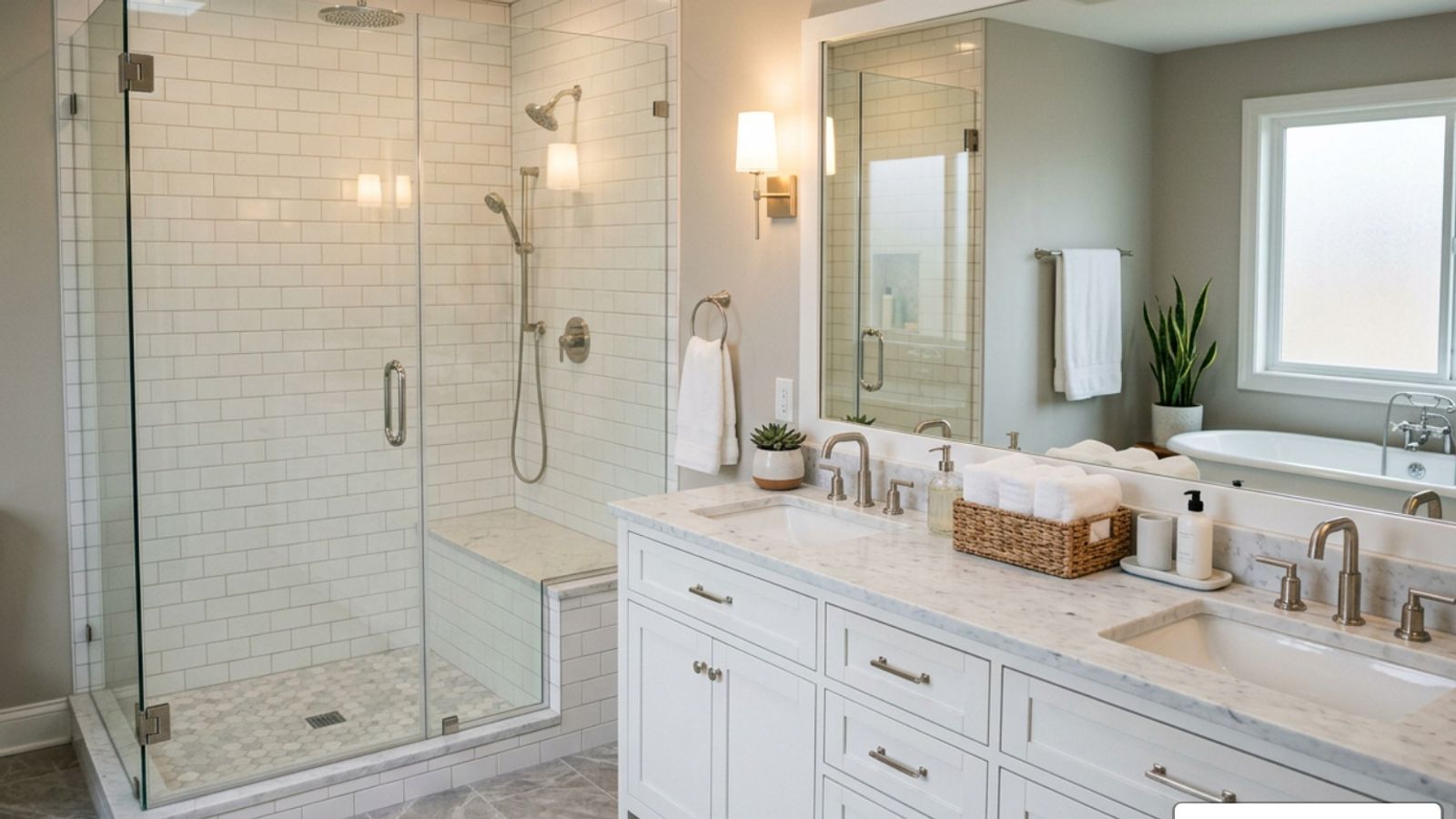
Bathroom Remodel Financing Options: A Step-by-Step Guide for Homeowners
Understanding your bathroom remodel financing options is the first step to turning an outdated, uncomfortable space into something that works for you — now and for years to come.
Here is a quick overview of the most common ways homeowners finance a bathroom remodel:
Financing Option
Best For
Requires Home Equity?
Home Equity Loan
Mid-to-large projects, fixed payments
Yes
HELOC
Phased projects, flexible draws
Yes
Cash-Out Refinance
Large projects, lower existing rate
Yes
Personal Loan
No equity, fast funding
No
FHA 203(k) / HUD Title I
Low-to-moderate income, accessibility
Sometimes
Contractor Financing
Convenience, promotional 0% periods
No
Credit Card (0% APR)
Small projects under $10,000
No
Each option comes with different rates, risks, and timelines. The right choice depends on your equity, credit score, project size, and how quickly you need to get started.
Bathrooms are one of the highest-return renovations you can make — mid-range remodels typically recoup around 67% of project costs at resale. But beyond resale value, a well-designed bathroom can dramatically improve daily comfort and safety, especially for homeowners planning to age in place.
The gap between a frustrating, outdated bathroom and a functional, modern space is often a financial one. This guide walks you through every realistic way to close that gap.
I'm Henry Rouhana, founder of Sure-Fix Remodeling in Easton, Pennsylvania, and over two decades of managing high-end bathroom renovations have given me a front-row seat to how financing decisions make or break a project. I've put together this guide specifically to help homeowners like you navigate bathroom remodel financing options with clarity and confidence — not confusion.
Step 1: Evaluating Average Costs and ROI in 2026
Before picking a loan program or signing a contract, you need a clear-eyed look at what a bathroom renovation actually costs in 2026. Renovations are an investment in your home’s functionality and market equity, but costs vary widely depending on project scope.
Across the United States and specifically in our local communities throughout the Lehigh Valley, PA (including Bethlehem, Allentown, Coopersburg, and Center Valley) and Western New Jersey (such as Phillipsburg, Warren County, and surrounding areas), project costs break down into distinct ranges:
- Powder Room / Guest Bath Refresh: Minor cosmetic updates, fixture swaps, or basic tile work generally range from $6,639 to $14,000.
- Standard Full Hall Bath Remodel: Comprehensive replacements of vanities, flooring, lighting, and tub surrounds average between $14,000 and $20,000.
- Master Suite Overhaul: High-end tile work, custom frameless glass enclosures, double vanities, and structural adjustments typically start at $30,000 and can easily reach $45,000 to $60,000+.
Looking at internal industry completion data, the overall national customer average for a bathroom renovation hovers around $16,248.91. Specific layout modifications carry tailored price points:
- Bathtub to Shower Conversion: Averages $18,310.52. If you are looking to replace an awkward, slippery tub with a spacious curbless shower, review our dedicated guide on Bathroom Remodel Tub to Walk-In Shower.
- Shower Upgrades: Average $15,794.85.
- Complete Gut & Remodel: Averages $15,154.50.
- Bathtub Replacement & Surround: Averages $14,934.05.
Resale Value and Cost Recoupment
Is funding a bathroom renovation worth it? Absolutely. Remodeling trends show that bathroom costs rise by roughly 7.8% annually due to material and labor costs. Financing now locks in today's construction pricing rather than waiting years while savings accounts struggle to outpace inflation.
From an equity perspective, bathroom updates deliver excellent resale value:
- Mid-Range Bath Remodel: Recoups approximately 67.2% of its cost upon resale.
- Upscale / Custom Luxury Bath: Recoups approximately 60.2% of its cost upon resale.
When planning your total loan amount, financial experts generally advise keeping your total bathroom project cost within 5% to 10% of your home's total market value. This guarantees you build real equity without over-customizing beyond regional neighborhood standards.
Step 2: Comparing Top Bathroom Remodel Financing Options
No single financing vehicle fits every homeowner. The right path depends on your existing mortgage rate, built-up equity, credit profile, and repayment timeline. Let's compare the core bathroom remodel financing options available in 2026.
Financing Vehicle
Interest Rate Type
Typical Rate Range (2026)
Max Repayment Term
Major Advantage
Major Downside
Home Equity Loan
Fixed
7.75% – 10.0%
15–30 Years
Predictable monthly payment; tax deductible interest
Uses home as collateral; 2%–6% closing costs
HELOC
Variable
8.0% – 10.5%
10-Yr Draw / 20-Yr Pay
Pay interest only on what you draw
Variable interest rates can rise
Cash-Out Refinance
Fixed
Current Mortgage Rates
15–30 Years
Consolidates debt into one loan
Resetting low pre-2023 mortgage rates is costly
Personal Loan
Fixed
6.25% – 35.99%
1–30 Years
Fast funding (1–3 days); no home equity required
Higher APR for lower credit scores
Contractor Financing
Fixed or Promo
0% Promo or 6.99%–24.99%
12 Mos to 15 Years
Instant point-of-sale pre-approval
High interest if promo period is missed
0% APR Credit Card
Fixed (Promo)
0% (21.39%+ post-promo)
12–21 Months
Zero interest if paid within promo window
Severe deferred interest risks
Home Equity Loans vs HELOCs: Secured Bathroom Remodel Financing Options
Secured loans leverage the equity built up in your house. Because your real estate serves as collateral, lenders face less risk and offer lower interest rates than unsecured products.
Home Equity Loans (Second Mortgages)
A home equity loan delivers a single lump-sum payout that you repay over a fixed term (typically 5 to 30 years) at a fixed interest rate.
- Pros: Your rate never changes, ensuring fixed monthly payments across the life of the loan. Furthermore, IRS guidelines state that interest paid on home equity loans is tax-deductible if the borrowed funds are spent directly to buy, build, or substantially improve the home securing the loan.
- Cons: You will pay closing costs equal to 2% to 6% of the loan amount. Most lenders cap your Combined Loan-to-Value (CLTV) ratio at 85% of your home's appraised value. Most importantly, failing to make payments risks property foreclosure.
Home Equity Lines of Credit (HELOCs)
A HELOC operates like a credit card backed by your property. You get access to a credit line with a "draw period" (usually 10 years) during which you can borrow funds as needed, followed by a repayment period (often 20 years).
- Pros: You only draw what you need, paying interest exclusively on the active balance. This makes HELOCs perfect for phased renovations or projects where final material choices might shift your budget mid-stream.
- Cons: HELOCs almost always feature variable interest rates. If benchmark interest rates rise, your monthly payment will increase.
Cash-Out Refinancing
Cash-out refinancing replaces your existing primary mortgage with a brand-new, larger mortgage, handing you the difference in cash.
- When it makes sense: Only if current mortgage rates are lower than your existing rate. If you locked in a sub-4% primary mortgage years ago, executing a cash-out refinance at 2026 rates just to access $20,000 or $30,000 for a bathroom remodel is a costly mistake that could cost you tens of thousands in added lifetime interest.
Personal Loans and Unsecured Bathroom Remodel Financing Options
Unsecured personal home improvement loans require no collateral, no home equity, no home appraisal, and no property lien. Your eligibility and interest rate are determined by your credit score, income, and debt-to-income (DTI) ratio.
To learn more about top-ranked lenders, review the Best Bathroom Remodel Financing Loans in April 2026 resource.
Advantages of Personal Loans
Speed: While home equity products take 30 to 60 days to process and appraise, unsecured personal loans often pre-approve in 60 seconds and deposit funds directly into your bank account within 1 to 3 business days.
Zero Home Risk: Your house is not tied to the debt. If life presents unexpected financial hardships, your primary residence isn't at risk of foreclosure.
Flexible Terms: Lenders like LightStream, Upgrade, Best Egg, and HFS Financial offer unsecured loan amounts ranging from $5,000 up to $450,000 with fixed repayment terms from 1 to 30 years.
Disadvantages of Personal Loans
- Higher minimum APRs compared to secured equity loans.
- Origination fees ranging from 1% to 15% depending on your credit tier.
Contractor-Offered Plans and Credit Cards
Many homeowners prefer the simplicity of arranging financing right at the kitchen table.
Contractor-Offered Financing
Contractors frequently partner with third-party fintech lenders (such as GreenSky or specialized home improvement financing firms) to provide point-of-sale loans.
- Interest-Bearing Plans: These feature fixed rates (often starting around 6.99% to 12.99%) spread over terms from 60 to 180 months.
- Promotional "Same-as-Cash" Plans: Popular promotions include "12 Months No Interest, No Payments" or "24 Months Equal Payments at 0% APR." For more details on promotional structures, see Bathroom Remodel Financing | 12 Months No Interest, Same as Cash | USA Bath.
A quick warning on deferred interest: If you accept a 12-month zero-interest promotional offer, you must pay off 100% of the loan balance before the final promotional day. Missing the deadline by even one day can trigger retroactive interest accumulation at standard rates near 30% APR back to day one!
Using Credit Cards
Using a standard credit card for a major renovation is generally ill-advised—the national average credit card APR sits at 21.39%, compared to 11.14% for a standard personal loan.
However, if you are completing a smaller powder room refresh under $10,000, opening a new credit card with a 0% APR introductory window of 15 to 21 months can work well. As long as you break your total cost into equal monthly payments and clear the balance before the promo period expires, you enjoy a zero-cost loan.
Government-Backed Renovations and Accessibility Loans
If you are renovating a bathroom for safety, mobility, or basic structural upgrades, government-supported lending programs provide accessible alternatives:
- FHA 203(k) Rehabilitation Loans: Allows buyers or current owners to combine home purchase or refinance costs with up to $75,000 or more in renovation capital under a single government-backed mortgage.
- HUD Title I Property Improvement Loans: Government-insured loans designed specifically for basic home habitability, utility updates, and safety improvements. They are easier to qualify for if you have limited home equity or fair credit scores.
- Accessibility and Aging-in-Place Modifications: If your renovation involves barrier-free showers, curbless entries, walk-in tubs, or reinforced grab bar framing, specialized disability grants or local housing authority programs may help off-set out-of-pocket spending. Explore functional design layouts in our guide on Barrier-Free Bathroom Design.
Step 3: Assessing Credit Score, Approval Speed, and Interest Rates
Your credit profile is the single biggest factor dictating your interest rates, monthly payments, and total borrowing limits. Lenders categorize applicants into clear credit tiers:
Credit Score Tiers and What They Mean
- Excellent Credit (740+): Unlocks the absolute lowest APRs (starting around 6.25% to 7.8% fixed), zero origination fees, and maximum borrowing flexibility across secured and unsecured lenders.
- Good Credit (680 – 739): Qualifies easily with major personal loan providers (like Splash or Axos) and home equity lenders, securing competitive rates with minimal processing delays.
- Fair Credit (580 – 679): Qualifies with specialized lenders like Upgrade, Universal Credit, or Best Egg. Expect higher interest rates (15% to 24%) and potential origination fees up to 8%.
- Subprime / Bad Credit (Under 580): Unsecured personal loans become difficult to secure. Options narrow to secured loans (requiring collateral), bad-credit lenders like OneMain Financial or Reprise, or contractor-assisted plans.
For additional geographic-specific lending strategies, see Bathroom Remodel Loans in Orlando, FL: No Equity Required | HFS Financial.
How Credit Inquiries Work
When exploring options, never allow multiple lenders to perform hard credit pulls at once. Always opt for lenders offering soft credit pre-qualification inquiries. Soft pulls take about 60 seconds and allow you to view exact rate estimates, borrowing limits, and monthly payments without harming your FICO score.
Approval and Funding Speeds
If you are facing an emergency repair—such as a cracked shower pan leaking water into your ceiling—time is critical.
- Personal Loans: 1 to 3 business days from application to funds in your account.
- Contractor In-House Financing: Decisions returned within 10 to 15 minutes during an in-home design consultation.
- Home Equity Products: 30 to 60 days due to required title searches, home appraisals, and formal underwriting.
Step 4: Accounting for Hidden Renovation Costs and Hybrid Payment Strategies
One of the biggest financial mistakes homeowners make is borrowing only the exact amount on the initial design quote. Demolition often reveals hidden issues behind old tile and drywall.
Common Hidden Costs to Factor Into Your Loan
Hidden Plumbing and Subfloor Damage: Water damage behind old tile or rotting subfloors under leaking toilets adds $500 to $2,500 in emergency repairs during demolition.
Outdated Electrical Systems: Upgrading older wiring to meet modern GFCI code standards for high-draw fixtures or heated towel racks can add $500 to $1,500.
Municipal Building Permits: Depending on whether you are relocating plumbing lines or opening structural walls in local municipalities like Lawrence Township or Bethlehem, building permits range from $100 to $500.
Layout Conversions: Moving drains, vent stacks, or supply lines increases labor costs significantly compared to keeping existing plumbing footprints intact. Read more about layout changes in our guide on Bathroom Conversion.
Always build a 10% to 15% contingency reserve directly into your loan request. If you don't spend it, you can apply it directly to your loan balance!
The Hybrid Payment Strategy
You don't have to choose between paying 100% cash or financing 100% of the bill. Combining cash savings with low-interest financing is often the smartest financial approach.
For example: On a $20,000 project, paying $5,000 from cash savings and financing the remaining $15,000 via a 5-year fixed loan keeps your liquid emergency fund intact while maintaining a manageable monthly payment of around $300 to $320 per month (at 7% to 8% interest).
Step 5: Choosing Between Fixed-Rate and Variable-Rate Financing
Selecting between a fixed-rate loan and a variable-rate loan comes down to your personal risk tolerance and project timeline.
When to Choose Fixed-Rate Financing
- You want financial predictability: Your interest rate and monthly payment remain locked for the entire loan duration (e.g., 5, 10, or 15 years).
- You are financing a large master bath: Long-term projects benefit from predictable payments.
- Current interest rates are reasonable: Locking in a rate protects you against future rate increases.
When to Choose Variable-Rate Financing (HELOCs)
- You plan to pay off the balance quickly: If you expect a work bonus, tax refund, or property sale within 12 to 36 months, a variable HELOC lets you draw cash immediately without paying long-term interest.
- Your project has an uncertain scope: If you are tackling a multi-phase renovation over several months, a HELOC allows you to draw and pay interest only on small increments as work progresses.
Frequently Asked Questions About Bathroom Remodel Financing
What credit score do I need for a bathroom remodel loan?
There is no single minimum score required across all lenders. Applicants with credit scores of 740 or higher receive the best interest rates and lowest loan fees. However, lenders like Upgrade and Universal Credit work with scores down to 580, while bad-credit lenders or specialized government products (like HUD Title I) support borrowers working to rebuild their credit profiles.
How fast can I get approved and funded for a bathroom remodel loan?
Prequalification using a soft credit check takes under 60 seconds online. Unsecured personal loans can be approved and funded directly into your checking account within 24 to 72 hours. In-house contractor financing can provide decisions within 10 minutes during your consultation. Conversely, equity-backed options (HELOCs and Home Equity Loans) take 3 to 6 weeks due to mandatory property appraisals and title searches.
Is the interest on a bathroom remodel loan tax deductible?
Under current IRS regulations, interest paid on home equity loans and HELOCs is tax-deductible only if the proceeds are spent directly on capital improvements that substantially add value to the home securing the loan. Unsecured personal loans and credit cards do not qualify for mortgage interest tax deductions. Always consult a licensed CPA or tax advisor regarding your tax situation.
Strategic Project Funding for Your Dream Bathroom
Navigating bathroom remodel financing options doesn't have to be overwhelming. Whether you choose an equity-backed product, an unsecured personal loan, or a convenient point-of-sale financing plan, aligning your funding with your long-term household budget guarantees a smooth renovation experience from demolition day to the final polish.
At Sure-Fix Remodeling, we believe high-quality craftsmanship should always come with straightforward, transparent pricing. Serving homeowners across Easton, PA, the greater Lehigh Valley, and neighboring Western New Jersey communities, our team works closely with you through our in-house showroom and design partnership—helping you plan, design, and realize your dream space without big-firm overhead or hidden fees.
Ready to explore your design ideas and budget choices? Check out our current Promotions, explore our comprehensive Bathroom Remodeling Services, or contact our team today to schedule your personalized design consultation!